
PDF Attached
Note
prices and basis can be found after the wheat section. We migrated to the cloud so it may take up to a month to get back up and running with multiple tables to support the reports that are issued on a daily basis
Calls:
(note
some are calling the market lower due to less than expected drop in crop conditions and StoneX survey results)
Corn
1-3 higher
Soybeans
2-4 higher
Wheat
steady higher
Volatile
trade was seen today. U.S. Delta will receive additional rain this week keeping producers out of the fields while drier weather will occur in the Midwest and Delta late this week. USDA announced 596,000 tons of corn was sold to China for 2020-21 delivery.
Malaysia was on holiday. Egypt seeks soybean oil and sunflower oil for November shipment. Algeria seeks 50,000 tons of wheat and it was confirmed Pakistan added 320,000 tons of wheat to their 1.5-million-ton import tender. South Korea’s MFG is in for 70,000
tons of feed wheat.

·
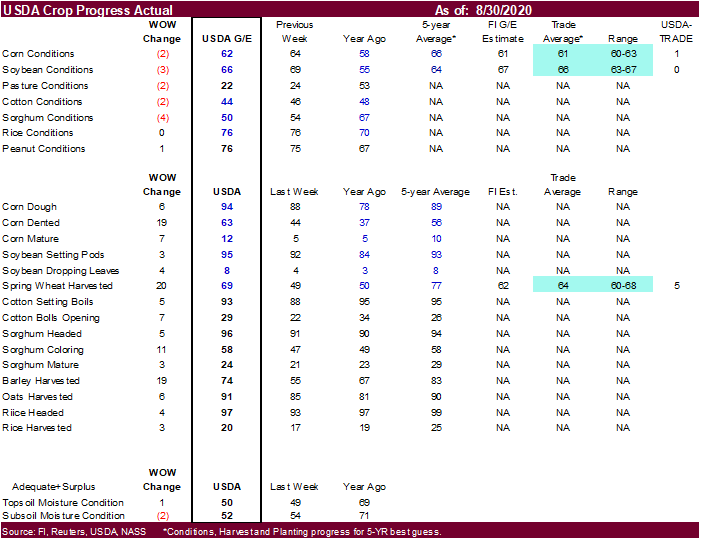
Corn 62% G/E down 2 pts (exp down 3pts), vs 64% last week, and 58% a year ago
·
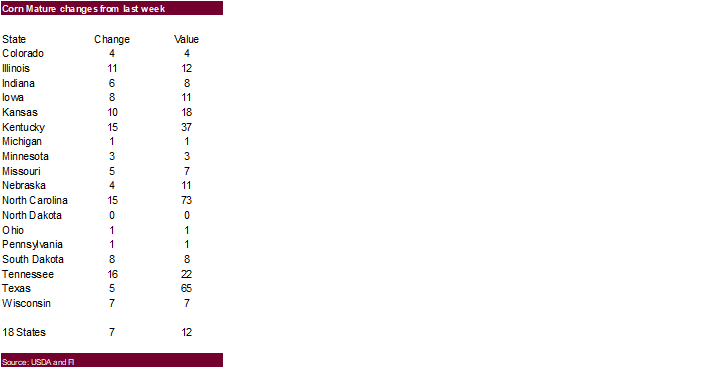
Corn mature 12% vs 5% last week, and 5% a year ago
·
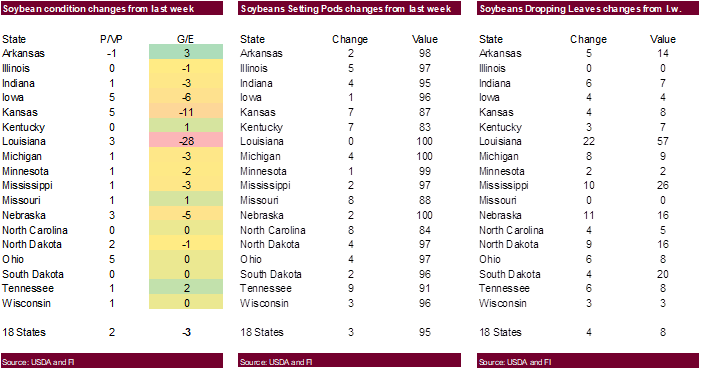
Soybeans 66% G/E down 3pts as expected, vs 69% last week, and 55% a year ago
·
Soybean drop leaves 8% vs 4% last week, and 3% a year ago
·
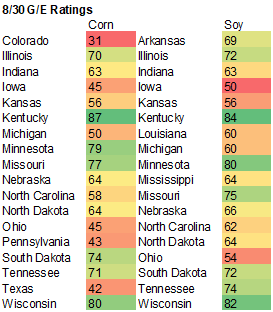
Louisiana Soy G/E down 28pts to 60% G/E on Hurricane Laura
·
Kansas Soy G/E down 11pts to 56% G/E on persistent dryness
·
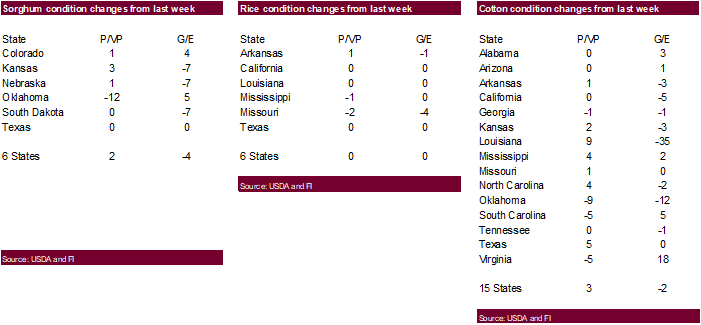
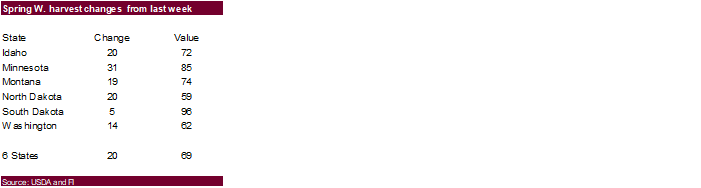
Spring wheat harvest 69% G/E vs 49% last week, and 50% a year ago
MOST
IMPORTANT WEATHER AROUND THE WORLD
- MAIN
THREATS AROUND THE WORLD - Typhoon
Maysak will bring horrific rain and wind to South Korea this week and heavy rain and flooding from North Korea into northeastern China; Wednesday through Friday will be stormiest
- New
tropical depression will form south of Japan this week and it will become a strong storm before moving across western Japan this weekend possibly causing some damage to agriculture and personal property - A
tropical depression may evolve this week in the Caribbean Sea and move toward Central America - Tropical
depression will form off the lower east U.S. coast early this week, but it will move away from land - Dryness
remains in portions of the western and central U.S. Corn Belt with only partial relief expected this week - Argentina’s
rainfall this week will not occur in the driest wheat areas, but some improved topsoil moisture will occur in the northeastern corn and sunseed areas
- Heavy
rain will continue in western and southern Mexico this week; flooding will be possible in Sinaloa, southwestern Chihuahua and western Durango and a few neighboring areas - Dryness
remains in Queensland, Australia and that may harm winter crop reproduction in the next two weeks - India’s
monsoon will begin to withdraw this coming weekend and next week - Heavy
rain will end in Gujarat, India and Sindh, Pakistan early this week with a little rain in southwestern Rajasthan as well
- Ivory
Coast and Ghana rainfall will slowly increase in the next two weeks; some beneficial rain occurred in Ivory Coast coffee and cocoa areas during the weekend - Western
Europe rainfall may increase after this workweek and into next week - Drought
will prevail in central and eastern Ukraine into Bulgaria and from eastern Ukraine into Russia’s Southern Region and western Kazakhstan - Frost
and freezes may evolve in parts of Canada’s Prairies during the weekend with some frost “possible” in the northernmost U.S. Plains and uppermost Midwest near the Canada border; confidence in the U.S. frost is still a little low, but Sep. 6-8 will be coldest
and a few light freezes cannot be ruled out
WEATHER
ISSUES IN DETAIL
- U.S.
weekend weather was mostly dry from portions of Iowa through much of northeastern Missouri to much of Illinois and parts of west-central and southwestern Indiana - Limited
rainfall also occurred in the northern Plains - Much
of central and southern Texas was dry along with central parts of the Delta and in the southeastern states from much of Georgia to central and eastern North Carolina and eastern Virginia - Rain
fell in Wisconsin, western and southern Michigan, northern Indiana and much of Ohio except the southwest - Amounts
ranged from 0.35 to 1.68 inches - Rainfall
in southern Michigan and northeastern Indiana to northern and eastern Ohio where 1.00 to 2.00 inches of rain resulted - Local
totals reached up to 3.00 inches - Remnants
of Hurricane Laura produced 1.00 to 3.00 inches and local totals over 4.00 inches from northeastern Arkansas to Kentucky, Tennessee, northeastern Mississippi and northern Alabama - Rain
fell across Kansas, the Texas Panhandle and eastern Oklahoma, Arkansas and western and southern Missouri
- Moisture
totals varied from 0.50 to 1.60 inches with locally greater amounts - Scattered
showers also occurred from eastern Texas through the central Gulf of Mexico coast to parts of Florida with 0.25 to 1.00 inch of rain with local totals of 1.00 to more than 3.00 inches
- Hot
weather occurred Friday from the central Plains into the Midwest with highest temperatures in the 90s
- Hot
weather occurred most of the weekend in the southern Plains with highs in the range of 100 to 111 degrees Fahrenheit
- Cooling
occurred in much of the northern and central Plains and Midwest during the weekend with highs Sunday afternoon in the 70s
- Lowest
morning temperatures were no cooler than the 40s and 50s in the northern states and were as warm as the 70s across the southern states - U.S.
Delta weather through mid-week will remain too wet for rice and cotton quality - Drier
weather is needed immediately to protect crop conditions - A
near daily rainfall pattern is expected over the next ten days which may prevent meaningful drying from occurring while cotton is in the open boll stage of development and which rice is being harvested - Frequent
showers and thunderstorms will also continue through the next ten days in the U.S. southeastern states there may also be some ongoing concern over crop quality
- U.S.
Midwest weather over the next two weeks will be well mixed with periods of rain and sunshine expected; however, some of the crop areas in Iowa and a few other areas in the west will experience net drying conditions - Milder
temperatures this week will conserve soil moisture through lower evaporation rates, but those areas suffering from dryness will continue stressed - Most
of the declines in production potentials will be slowed by the coming ten days of periodic showers and milder temperatures, but no reversal in the production cuts are likely in the western Corn Belt and until significant rain falls some further decline in
production may result even though it will be smaller than the previous losses - Eastern
and southern Midwest locations will receive plenty of moisture to support improved late season crop conditions - West
Texas may receive some rain Tuesday and Wednesday, but it will not soak the region - Temperatures
will gradually cool down from the hot readings of the weekend and will become more seasonable during the second half of this week
- Very
little rain will fall in the far western United States over the coming week and temperatures will begin trending warmer than usual as the week advances forward
- Far
southern Canada’s Prairies and the northwestern U.S. Plains will continue to experience restricted rainfall and net drying conditions for the next ten days - Other
areas in the Prairies will experience a mix of weather with rainfall sufficient to increase topsoil moisture; this may lead to a slowdown in crop maturation and harvest progress - The
drier areas will continue to experience faster crop maturation rates relative to normal and a quick harvest - Ontario
and Quebec will experience a good mix of rain and sunshine over the next two weeks; some drying will be needed thereafter to induce better crop maturation and harvest conditions - Mexico
rainfall will be greatest in the west and south this week bolstering soil moisture and inducing some local flooding - Some
areas are already saturated with moisture and will be succumb to the excessive moisture raising some concern over crop conditions - Central
America rainfall will be frequent and significant - Argentina
rainfall this week will be greatest Tuesday and Wednesday in the northeast and east-central parts of the country
- Entre
Rios, southern Corrientes and Santa Fe will be wettest with 0.40 to 1.50 inches and a few totals over 2.50 inches
- Rain
elsewhere will not be significant - Most
other areas will experience erratic rainfall over the next ten days with net drying most likely leaving moisture stress for Cordoba, many Santa Few locations and some other areas - Brazil
rainfall will be frequent in the far south during the next ten days followed by a drier biased environment after that - Rainfall
of 2.00 to 5.00 inches and locally more will occur from southeastern Parana to southern Rio Grande do Sul, Brazil with some lighter rain in northwestern Rio Grande do Sul - Net
drying is expected elsewhere except along the coast where rainfall may vary from 0.04 to 0.35 inch most days with a few totals over 0.50 inch - The
environment will be good for most crops, although a few wheat areas might become a little too wet; corn planting should advance in the drier areas and on the drier days - South
Africa will receive some rain east of Northern Cape Tuesday and Wednesday resulting in a short term boost in topsoil moisture for wheat and barley - More
rain will impact eastern wheat and barley production areas late in the coming weekend and early next week - Improved
wheat conditions will result, although more rain will be needed - Western
South Africa will also experience some light rainfall early to mid-week this week benefiting some wheat, barley and canola crops - A
few more showers will occur during the weekend - Other
showers will occur at times through next week, but the resulting rainfall will be erratic and light - West-central
Africa rainfall is expected to slowly ramp up over the next two weeks - Ivory
Coast and Ghana need rain after two months of mostly dry conditions - Rain
expected over the next two weeks will not be uniformly distributed, but it will prime the atmosphere with moisture needed to generate more generalized areas of rain later in September - Some
benefit will come from the next two weeks of showers, but greater rain will be needed - Europe
weather will remain drier biased for France and central Germany through Saturday, but after that rain is expected to bring relief to the dry region - The
moisture will be good for future autumn planting of winter crops, but may disrupt crop maturation and harvest progress early this autumn - Central
through northeastern Europe will be wettest this week with periods of rain continuing to maintain moisture abundance and a good environment for crop development - A
few days of drying will occur during the weekend and early next week only to be followed by waves of new rain later next week - The
environment will be good for late season crops, but may interfere with crop maturation and harvest progress - Southeast
Europe will be dry biased over the coming ten days to two weeks - Areas
from central and eastern Ukraine to central and eastern Bulgaria will see very little rainfall and temperatures will be warmer than usual - Crop
stress will continue high in this region with a further decline in summer crop yields and quality
- Faster
than usual crop maturation and harvest progress is expected this year as long as rainfall stays limited - Rain
fell from southern France through northern Italy to Czech Republic during the weekend with excessive rain and flooding in parts of northern Italy - Rain
totals varied from 2.00 to more than 5.00 inches in the Po River Valley with nearly 10.00 inches in the Swiss Alps - Rain
also fell in the U.K., northern France, Belgium and Netherlands - Drying
occurred in many other areas with drought conditions most serious in southeastern Europe - Warmer
than usual temperatures occurred from southern Spain through Italy to most of the Balkan Countries and southwestern Ukraine where highest temperatures were in the 90s Fahrenheit - Highs
in the 50s and 60s occurred in the U.K. while in the 60s and 70s elsewhere in northern Europe
- Scattered
showers and thunderstorms occurred across western Russia and in a part of the New Lands during the weekend while Ukraine and Russia’s Southern Region was relatively dry with mild to warm temperatures - Highest
temperatures were in the 50s and 60s Fahrenheit across the northern CIS while in the 80s and lower 90s farther to the south - Russia’s
New Lands will continue to experience some brief periods of drizzle and light rain over the coming week to ten days
- Most
of the precipitation will be very light, but there is some concern over unharvested small grain and sunseed quality - Dry
and warm weather is needed to induce the best maturation and harvest conditions - A
favorable mix of weather will occur over the next ten days in other western CIS locations, but net drying will continue in central and eastern Ukraine, Russia’s Southern Region and western Kazakhstan - Temperatures
will be very warm to hot in this region as well - Typhoon
Maysak threatens to damage rice, corn, soybeans and sugarbeets from South Korea to northeastern China Wednesday into Friday of this week - Torrential
rain and flooding are expected along with excessive wind and a notable storm surge in South Korea - Maysak
was located 144 miles south of Okinawa, Japan at 24.7 north, 127.3 east at 0900 GMT today moving northerly at 21 mph and producing maximum sustained wind speeds of 115 mph with tropical storm force wind occurring out 200 miles - Typhoon
force wind was occurring out 55 miles from the storm center - A
new tropical depression is forming south of Japan and it will be closely monitored this week as it moves northward and possibly runs across central Japan’s rice and citrus areas as a tropical storm.
- Tropical
Disturbance in far eastern Caribbean Sea may become a tropical depression storm in the next few days while moving west northwest toward Central America - A
tropical depression may evolve early this week off the southeastern U.S. coast and will move away from land, but could contribute to some coastal rainfall early this week - Two
other tropical waves are expected in the central and eastern tropical Atlantic Ocean this week and need to be closely monitored for further development - Interior
east-central China will experience net drying this week and weekend while showers and thunderstorms slowly return to the southern provinces where some locally heavy rain is possible - A
mix of rain and sunshine will return in the Yellow River Basin and North China Plain next week
- Temperatures
will be warm except in the south where readings will be near average - China’s
late summer crops will need more drying later this month to promote maturation and improved harvest progress, but the rain will be good in winter wheat production areas where planting occurs in late September and October - Xinjiang
China will continue to experience alternating periods of mild and warm weather with a few showers northeast
- Warm
and dry weather is desirable to help speed cotton and other crops toward maturity after a slightly cooler than usual summer - Flooding
on China’s Yangtze River will continue for a while as the region continues to drain surplus water from behind the Three Gorges Dam
- Freezing
temperatures in eastern Australia have mostly ended - Damage
occurred to some winter crops last week, although Queensland is the only state that will suffer some yield decline because of the combined impact of freezes and drought - Other
Australia crops are rated favorably, although rain is needed from Western Australia into South Australia and these areas may dry down for while - Australia
rainfall in the coming week to ten days will continue limited to coastal areas with Victoria wettest along with southwestern Western Australia - Greater
rain is needed prior to reproduction - Queensland
winter crops should be reproducing in the next two weeks and rain is needed - India
weekend rainfall was greatest in Madhya Pradesh, northern Maharashtra and Gujarat - Rainfall
ranged from 2.75 to more than 6.00 inches resulting in some local flooding - A
little more than 8.00 inches occurred in southern Gujarat - Rain
also fell in other northern and west-central India locations as well as the far eastern states, but rain amounts in most of those crop areas was not heavy enough to present serious issues for crops - Net
drying occurred in southern and interior eastern parts of India - Temperatures
were near to slightly above average - India’s
greatest rainfall this week will be today from Gujarat and Sindh, Pakistan into southwestern Rajasthan - Rainfall
will range from 1.00 to 3.00 inches with local totals to more than 5.00 inches - Some
heavy rain is also expected early this week in northern Pakistan, far southern and extreme eastern India where 1.00 to 3.00 inches and local totals over 4.00 inches will result - Net
drying will occur elsewhere - Rain
will fall in central, southern and eastern India later this week through next week while the monsoon pattern slowly begins to withdraw from the north of India - The
drier bias will be welcome especially to cotton harvesting which has experienced a threat to quality because of recent rain - Pakistan
cotton, rice and sugarcane in Sindh will receive more rain early this week and then monsoonal precipitation will begin to withdraw in the balance of the coming two weeks improving cotton maturation and harvest progress - Irrigated
rice, sugarcane and other crops will become more dependent upon irrigation water for late season crop development as seasonal drying begins - A
good mix of rain and sunshine is expected in mainland areas of Southeast Asia over the coming ten days - Indonesia
rainfall continues erratic - Sumatra
has been steadily drying recently and needs significant rain - Java
is also quite dry, but some of that dryness is seasonal - Rainfall
over the next ten days will continue erratic, but at least some rain will fall in each production area at one time or another - Rain
is needed most in parts of Sumatra and western Java -
Philippines
weather has been trending a little drier recently and this trend may continue for the coming week to ten days -
Temperatures
will be seasonable -
Mainland
Southeast Asia is getting enough rain to support summer crops, but there is a growing concern over off season water supply since summer rainfall has not been as great as needed to restore those supplies -
New
Zealand rainfall will be erratically distributed for a while and temperatures will be a little cooler biased -
Below-average
rainfall is expected in North Island and eastern parts of South Island -
Southern
Oscillation Index was +8.97 today and it will continue positive and will likely rise additionally early this week
Source:
World Weather
- USDA
weekly corn, soybean, wheat export inspections, 11am - U.S.
crop conditions for soybeans, corn, cotton; wheat harvesting progress, 4pm - Statcan
data for Canada wheat, barley, soy, canola and durum production - EU
weekly grain, oilseed import and export data - Ivory
Coast cocoa arrivals - Holiday:
U.K., Malaysia
TUESDAY,
SEPT. 1:
- Australia
commodity index - U.S.
Purdue agriculture sentiment - USDA
soybean crush, 3pm - U.S.
corn for ethanol, DDGS production, 3pm - FO
Licht’s virtual Sugar and Ethanol Conference, Sao Paulo (Sept. 1-3) - Cotton
outlook update by International Cotton Advisory Committee in Washington - New
Zealand global dairy trade auction - Honduras,
Costa Rica coffee exports - Malaysia
palm oil export data for August 1-31
WEDNESDAY,
SEPT. 2:
- EIA
U.S. weekly ethanol inventories, production, 10:30am - UkrAgroConsult’s
Black Sea Grain Conference in Kyiv (Sept. 2-3) - Russia’s
Agriculture Ministry holds annual conference to discuss production and the industry - HOLIDAY:
Vietnam
THURSDAY,
SEPT. 3:
- USDA
weekly crop net-export sales for corn, soybeans, wheat, cotton, pork, beef, 8:30am - FAO
World Food Price Index - Port
of Rouen data on French grain exports - New
Zealand commodity price
FRIDAY,
SEPT. 4:
- ICE
Futures Europe weekly commitments of traders report, 1:30pm (6:30pm London) - CFTC
commitments of traders weekly report on positions for various U.S. futures and options, 3:30pm - CNGOIC’s
monthly supply-demand report on Chinese feed grains and oilseeds - FranceAgriMer
weekly update on crop conditions - StatsCan’s
data on Canada wheat, barley, soy, canola and durum stocks - HOLIDAY:
Thailand
Source:
Bloomberg and FI
StatsCan
July estimates of production of principal field crops
2018 2019 2020 2018-2019 2019-2020
thousands of tons % change
Total wheat
32201 32348 35740 0.5 10.5
Durum
wheat 5745 4977 6926 -13.4 39.2
Spring
wheat 23942 25670 25935 7.2 1.0
Winter
wheat 2514 1701 2879 -32.4 69.3
Barley
8380 10383 10546 23.9 1.6
Canary
seed 158 175 150 11.0 -14.4
Canola
20594 19477 19403 -5.4 -0.4
Chick
peas 311 252 205 -19.2 -18.6
Corn
for grain 13885 13404 13928 -3.5 3.9
Dry
beans 341 317 328 -7.1 3.5
Dry
field peas 3581 4237 4996 18.3 17.9
Fall
Rye 226 326 402 44.1 23.6
Flaxseed
492 486 553 -1.3 13.8
Lentils
2092 2242 2805 7.2 25.1
Mustard
seed 174 135 91 -22.5 -32.3
Oats
3436 4237 4498 23.3 6.1
Soybeans
7417 6045 5962 -18.5 -1.4
Sunflower
seed 57 63 95 9.8 51.5
USDA
inspections versus Reuters trade range
Wheat
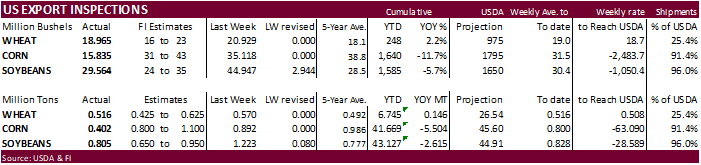
516,131 versus 400000-700000 range
Corn
402,216 versus 800000-1100000 range
Soybeans
804,591 versus 650000-1000000 range
GRAINS
INSPECTED AND/OR WEIGHED FOR EXPORT
REPORTED IN WEEK ENDING AUG 27, 2020
— METRIC TONS —
————————————————————————-
CURRENT PREVIOUS
———–
WEEK ENDING ———- MARKET YEAR MARKET YEAR
GRAIN 08/27/2020 08/20/2020 08/29/2019 TO DATE TO DATE
BARLEY
1,270 0 49 3,731 2,987
CORN
402,216 892,031 357,783 41,668,943 47,172,730
FLAXSEED
0 0 0 317 48
MIXED
0 0 0 0 0
OATS
100 0 0 900 299
RYE
0 0 0 0 0
SORGHUM
162,678 70,357 88,718 4,957,123 2,097,682
SOYBEANS
804,591 1,223,251 1,290,414 43,126,553 45,741,582
SUNFLOWER
0 0 0 0 0
WHEAT
516,131 569,593 558,523 6,744,636 6,598,431
Total
1,886,986 2,755,232 2,295,487 96,502,203 101,613,759
————————————————————————
CROP
MARKETING YEARS BEGIN JUNE 1 FOR WHEAT, RYE, OATS, BARLEY AND
FLAXSEED;
SEPTEMBER 1 FOR CORN, SORGHUM, SOYBEANS AND SUNFLOWER SEEDS.
INCLUDES
WATERWAY SHIPMENTS TO CANADA.
StoneX
Survey Numbers
Corn
179.6 from 182.4 last month
Prod
15085 from 15.320 billion
Soybeans
52.9 from 54.2
Prod
4388 from 4.496 billion
-
December
corn futures opened higher but turned lower by mid-morning day session on poor US corn shipments despite forward sales to China. September 1 marks a new-crop year, and some traders were booking end of month profits. December corn finished 1.50 cents lower
after hitting a 5-month high. -
US
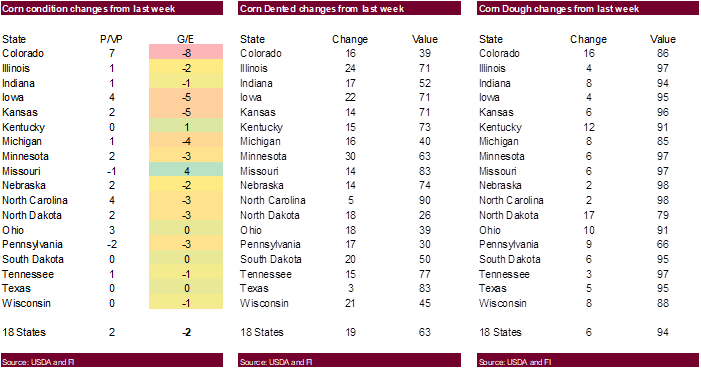
corn conditions declined by a less than expected 2 points (trade looking for 3) to 62 percent, compared to 58 percent year ago and 66 average. Colorado fell 8 points. Iowa and Kansas were down 5 points. Indiana fell 1 point and Illinois dropped 2 points.
-
USDA
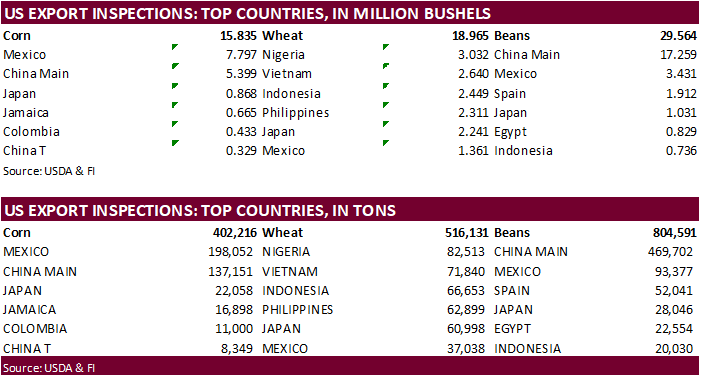
US corn export inspections as of August 27, 2020 were 402,216 tons, well below a range of trade expectations, below 892,031 tons previous week and compares to 357,783 tons year ago. Major countries included Mexico for 198,052 tons, China Main for 137,151 tons,
and Japan for 22,058 tons. -
The
low US Gulf corn inspection loadings were likely a result from disruption from the two storms and closures ahead of the hurricane shifting over TX. We think the low corn inspections supported soybean/corn spreading.
-
Funds
for corn were net even.
Corn
Export Developments
-
Under
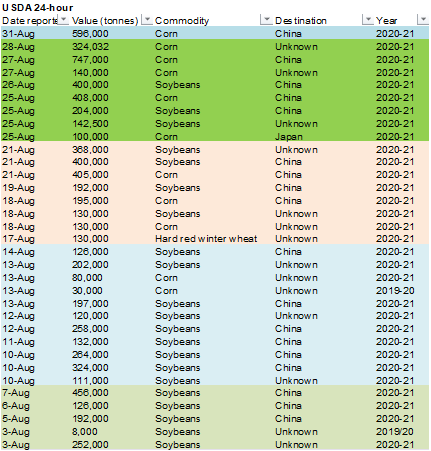
the 24-hour reporting system, private exporters reported to the U.S. Department of Agriculture the following activity: -
Export
sales of 596,000 metric tons of corn for delivery to China during the 2020/2021 marketing year.
-
December
is seen in a $3.40-$3.85 range.
-
CBOT
November soybeans were sharply higher Sunday into Monday but paid most of its gains on end of month profit taking. November soybeans hit their highest level since January 15 and on a rolling basis were at a 1-year high. The November contract settled 3.00
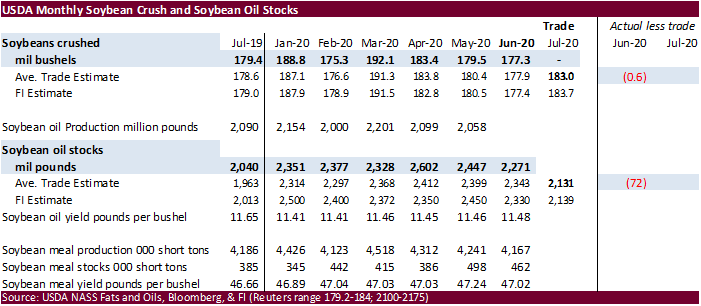
cents higher. October soybean oil was up sharply as well but turned lower by mid-session, trading in a wide 123-point outside day range. October soybean oil settled 37 points lower. The crush was higher as October soybean meal ended higher by $2.80. During
the session the October soybean meal contract hit its highest level since March 31.
-
Funds
bought an estimated net 2,000 soybean contracts, bought 4,000 soy meal, and sold 4,000 soybean oil.
-
US
soybean conditions declined 3 points this week to 66 percent, as expected, and compares to 55 year ago and 64 percent average. Louisiana fell 28 points, Kansas was down 11, Nebraska down 5 and Iowa down 6. Soybeans dropping leaves were reported at 8 percent.
-
USDA
US soybean export inspections as of August 27, 2020 were 804,591 tons, within a range of trade expectations, below 1,223,251 tons previous week and compares to 1,290,414 tons year ago. Major countries included China Main for 469,702 tons, Mexico for 93,377
tons, and Spain for 52,041 tons. -
China
soybean purchases from the US for Q4 shipment has been slow since early last week amid increase in CBOT soybean futures.
-
China
sold all of its 76,035 tons of soybeans offered at auction at an average price of 3,171 yuan per ton.
-
Since
July 1, the EU imported 2.57 million tons of soybeans (2.43MMT year earlier) and 640,000 tons of rapeseed (1.26MMT year earlier).
-
StatsCan
estimated the 2020 Canadian canola crop at 19.4 million tons, below a Reuters average trade guess of 20 million.
-
US
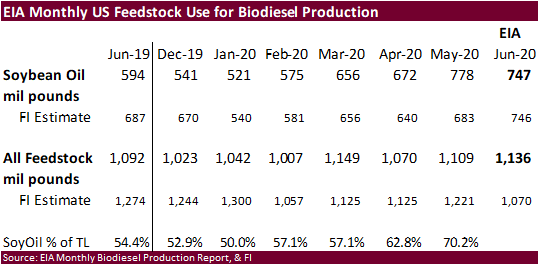
soybean oil for biodiesel production came in at our expectation, and we still look for use to end up 75 million pounds above USDA (see attached monthly soybean oil balance).
Reuters:
Brazil is unlikely to renew its non-tariff quota for ethanol imports that expires on Monday, forcing U.S. producers to pay a 20% tariff, a government official with knowledge of the matter told Reuters. Brazil’s foreign trade chamber Camex said that if the
quota is not renewed by the end of the day, the tariff will be re-imposed, affecting U.S. corn ethanol coming into Brazil.
-
Egypt’s
GASC seeks local soybean and sunflower oil on September 3 for November 1-25 delivery.
-
November
soybeans are seen in a $9.25-$10.00 range. -
December
soybean meal is seen in a $290-$325 range. -
December
soybean oil is seen in a 32.50-35.00 range.
-
US
wheat futures traded higher in Chicago and KC and two-sided in Minneapolis. Short wheat crops in Britain and France have supported prices over the past month. A surge in Russian wheat export commitments last week increased cash prices for Black Sea origin,
making US wheat a little more competitive. The weakness in Minn wheat relative to Chicago and KC reflected a larger than expected Canadian wheat crop estimated by StatsCan. The Canadian wheat crop was pegged at 35.7 million tons, a 7-year high, and up from
32.3 million tons a year ago. -
Funds
bought an estimated net 5,000 contracts. -
US
spring wheat harvesting progress advanced 20 points to 69 percent. This was 5 points above expectations and compares to 50 year ago and 77 average.
-
IKAR
reported Russian 12.5%5 Black Sea wheat at $211/ton at the end of last week, up $9.00/ton.
-
IKAR
also estimated the Russian wheat crop at 82.8 million tons, up 300,000 tons from previous.
-
USDA
US all-wheat export inspections as of August 27, 2020 were 516,131 tons, within a range of trade expectations, below 569,593 tons previous week and compares to 558,523 tons year ago. Major countries included Nigeria for 82,513 tons, Vietnam for 71,840 tons,
and Indonesia for 66,653 tons. -
Paris
December wheat was down 1.00 at 185.50 euros (5-week high). -
The
EU exported 2.47 million tons of soft wheat since July 1, down from 4.63 million tons a year earlier.
The
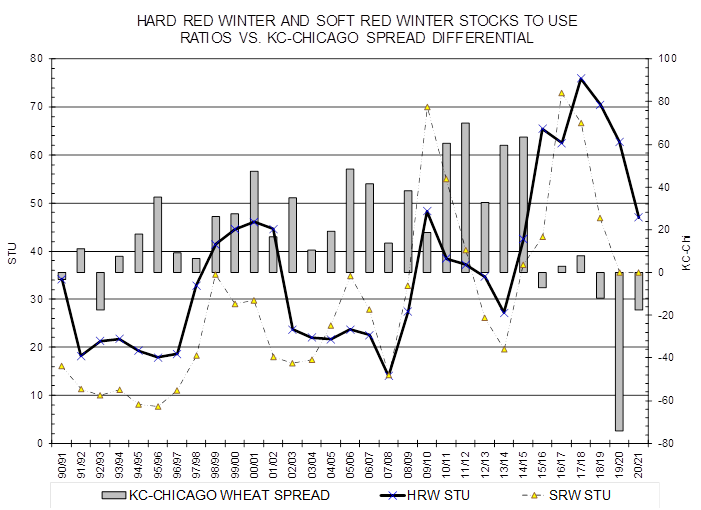
KC-Chicago wheat spread is expected to remain at traditional inverse levels this crop-year, due to a tighter HRW STU, unlike last year which was crushed due to a poor quality HRW wheat crop and abundant supplies.
-
South
Korea MFG seeks 70,000 tons of feed wheat for late Dec and/or early Jan shipment.
-
Syria
looks to sell and export 100,000 tons of feed barley with offers by Sep 1.
-
Algeria
seeks wheat on Sep 2 for October shipment. -
Pakistan
bought at least 320,000 tons of wheat from their import tender for up 1.5 million tons.
-
Jordan
issued another import tender for 120,0,00 tons of wheat set to close Sep 2.
-
Syria
seeks 200,000 tons of soft wheat from EU/Russia on Sept. 9 and 200,000 tons of wheat from Russia on Sept. 14. -
Results
awaited: Pakistan seeks 1.5 million tons of wheat. Lowest offer was $233.85/ton for 200,000 tons of milling wheat.
·
South Korea bought 60,556 tons of rice for Dec 31-Feb 28 delivery from Vietnam and India.
·
US rice traded higher on US crop concerns
Updated
8/31/20
- December
Chicago is seen in a $5.30-$5.75 range. - December
KC $4.50-$5.60. - December
MN $5.25-$5.70.
Terry Reilly
Senior Commodity Analyst – Grain and Oilseeds
Futures International │190 S LaSalle St., Suite 410│Chicago, IL 60603
W: 312.604.1366
AIM: fi_treilly
ICE IM:
treilly1
Skype: fi.treilly

Trading of futures, options, swaps and other derivatives is risky and is not suitable for all persons. All of these investment products are leveraged, and you can lose more than your initial deposit. Each investment product is offered
only to and from jurisdictions where solicitation and sale are lawful, and in accordance with applicable laws and regulations in such jurisdiction. The information provided here should not be relied upon as a substitute for independent research before making
your investment decisions. Futures International, LLC is merely providing this information for your general information and the information does not take into account any particular individual’s investment objectives, financial situation, or needs. All investors
should obtain advice based on their unique situation before making any investment decision. The contents of this communication and any attachments are for informational purposes only and under no circumstances should they be construed as an offer to buy or
sell, or a solicitation to buy or sell any future, option, swap or other derivative. The sources for the information and any opinions in this communication are believed to be reliable, but Futures International, LLC does not warrant or guarantee the accuracy
of such information or opinions. Futures International, LLC and its principals and employees may take positions different from any positions described in this communication. Past results are not necessarily indicative of future results.
 Evecom-FI083120.pdf