
PDF Attached
USDA
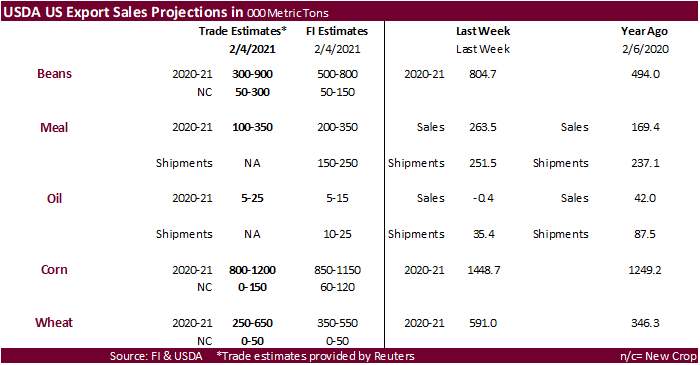
export sales will be out Friday.

USDA
Agriculture Outlook Forum
USDA
comments/speeches from the annual agriculture outlook forum will trickle out over the next week. Slides/speeches posted here
https://www.usda.gov/oce/ag-outlook-forum/aof-program
Or
follow it on Twitter
https://twitter.com/hashtag/AgOutlook?src=hashtag_click
NASS
is due out Friday with their initial 2021-22 US S&D statistical estimates. Those will be available to everyone early Friday.
https://www.usda.gov/oce/ag-outlook-forum
US
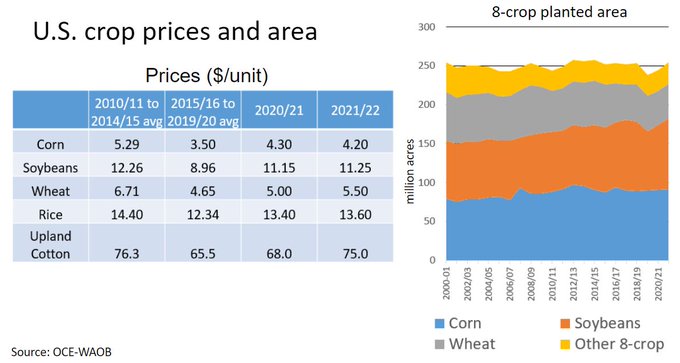
area:
Corn
92
Soybeans
90
Wheat
45
Cotton
12 (that is higher than National Cotton Council)
Average
$
Corn
$4.20
Soybeans
$11.25
Wheat
$5.50
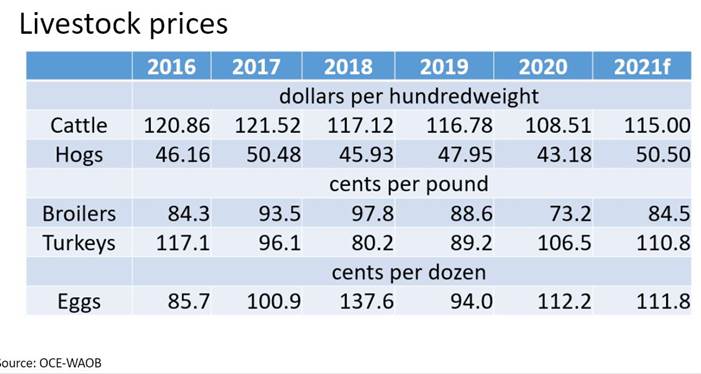
Cattle
115.00
Hogs
50.50
Chief
Economist Seth Meyer: drought impacted the size of the crop this year, but events such as the Derecho had a significant impact
Chief
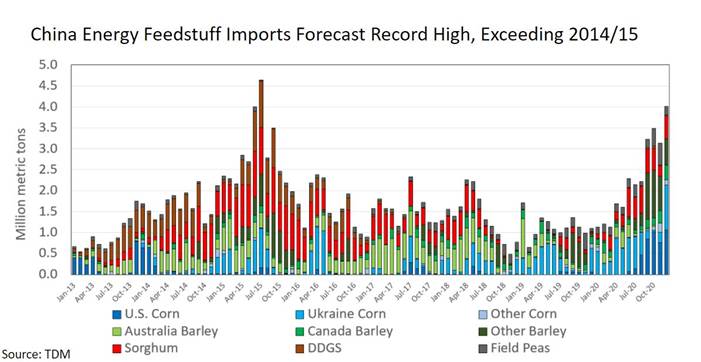
Economist Seth Meyer: China imports have been very corn focused
Chief
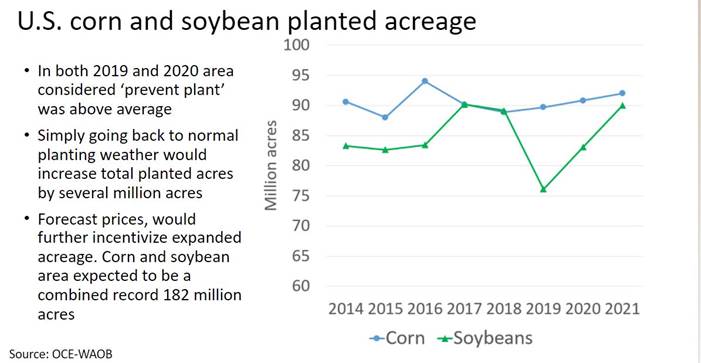
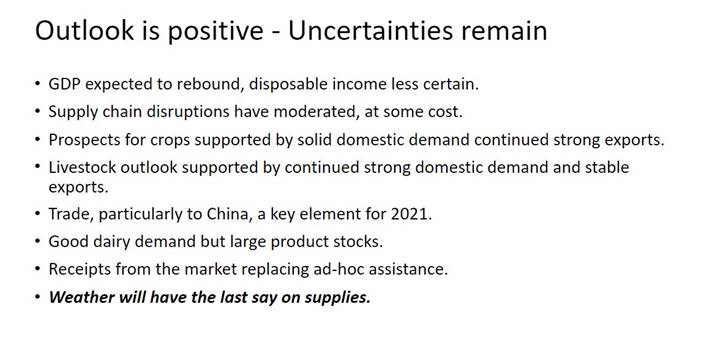
Economist Seth Meyer: if one assumes, we have normal planting weather, we will have an increase in total planted acres. But that’s entirely dependent on the weather
USDA
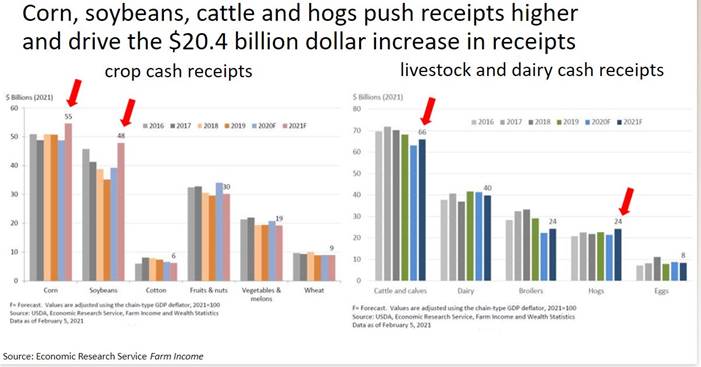
SEES FISCAL 2021 U.S. FARM EXPORTS AT $157 BLN
USDA
SEES U.S. FARM EXPORTS TO CHINA AT $31.5 BLN IN FY 2021
-
NWS
30-Day Outlook for U.S. – is classic La Nina -
March
was advertised to be wetter than usual in the Midwest (east of the Mississippi River) and northeast into New York and northwestern New England -
The
wet bias extends southward into Tennessee -
March
was also wetter biased in Montana, northwestern Wyoming and the mountains of Idaho -
Below
average precipitation was suggested for the central and southern Plains, Gulf of Mexico coastal areas, Florida, central and southern Georgia, South Carolina and southeastern North Carolina as well as in the southern Rocky Mountains, the southwestern desert
region and central and southern California -
Equal
chances for above, below and near normal precipitation was advertised elsewhere -
Temperatures
in March were advertised warmer than usual in the majority of the nation, but not in the Pacific Northwest where readings were advertised colder than usual. -
Equal
chances for above, below and near normal temperatures was suggested for central California, Nevada, northern Utah, the Dakotas, northern Nebraska, Minnesota, northern Iowa, and much of Wisconsin -
NWS
90-Day Outlook for U.S. – also follows traditional La Nina bias -
March
through May temperatures will be warmer than usual except in Washington state, far northern Idaho and far northwestern Montana where readings were advertised cooler than usual -
There
was an equal chance for above, below and near normal temperatures from far northern California and Oregon through the remainder of Montana and northwestern Wyoming to North Dakota, much of Minnesota, Upper Michigan and northern Wisconsin -
March
through May precipitation was advertised wetter than usual in the heart of the Midwest (mostly east of the Mississippi River) and extending northeast into western and northern New York and far northwestern New England -
Washington
state and areas east into northwestern Montana were also advertised to be wetter biased -
Below
average precipitation was suggested for the central and southern Plains, the southern Rocky Mountain region, much of California and the southwestern desert region along with Nevada.
-
Florida
and areas from southern Georgia to Louisiana were also advertised to be drier than usual -
Equal
chances for above, below and near normal precipitation was suggested for most other areas.
-
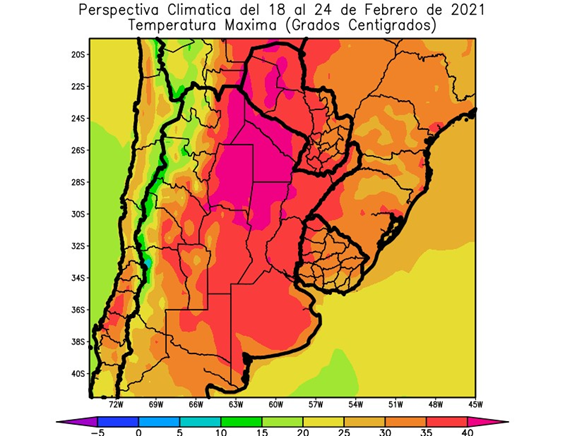
Argentina
weather will continue to dry down over the next ten days -
The
latest soil assessment shows most of the nation’s key crop areas still have good subsoil moisture -
Rapid
drying is expected in the coming week as temperatures turn seasonably warm and precipitation is limited to sporadic showers -
Greater
rain will be needed in the last days of February and early March to prevent moisture stress from becoming an issue for late season crops -
Today’s
GFS model suggested greater rain in the first week of March, but this was likely overdone -
Some
showers are expected, and they may offer some partial relief from previous drying -
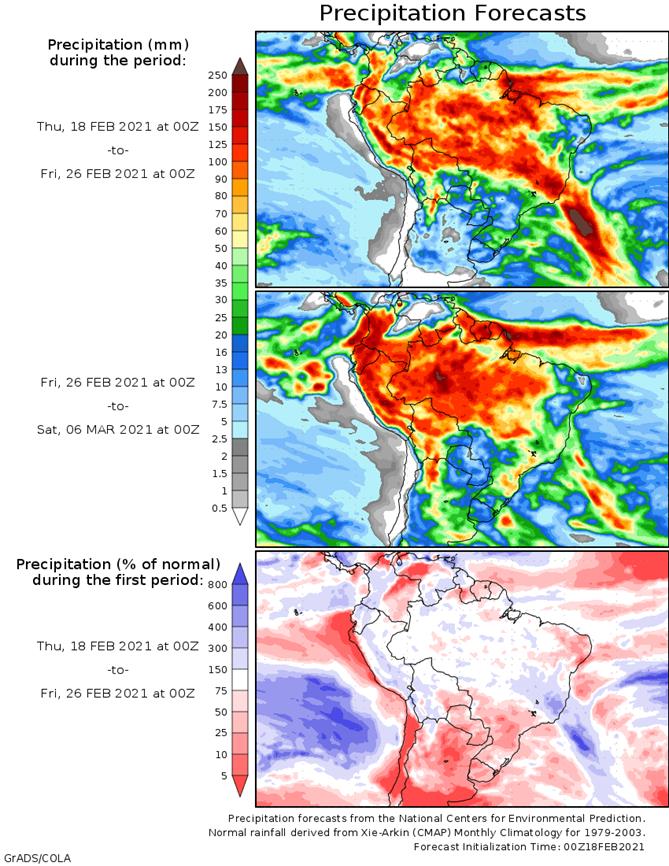
Brazil
crop weather will continue mixed -
Rain
frequency and intensity will remain a little greater than desired across Mato Grosso, Goias and Minas Gerais during the next couple of weeks -
However,
rain does not fall substantially every day and World Weather, Inc. believes enough drying will occur to support some slow field progress -
Southern
Brazil will experience less frequent and less significant rain and many areas from Mato Grosso do Sul and southwestern Sao Paulo into Rio Grande do Sul and Paraguay will experience a good mix of weather -
Enough
sunny and warm conditions will occur to promote soybean maturation and harvesting along with Safrinha corn planting -
Soil
moisture will remain supportive of ongoing full season and late season crops and there will be some timely rainfall to maintain those conditions -
Argentina
early soybeans were 50% setting pods and 6% filling pods last week -
Late
planted soybeans were 40% flowering -
This
data was provided from “Soybeans and Corn Advisor” -
Argentina
early corn was 52% filling and 16% mature -
Harvesting
was expected to begin this week -
Late
planted corn was 50% pollinated -
Corn
was rated 9% poor, 69% average and 23% good to excellent that compares to 25% good to excellent last week and 62% average -
This
data was provided from “Soybeans and Corn Advisor” -
South
Africa will experience net drying through the weekend, but timely rain will fall in many areas next week maintaining a very good production outlook -
Recent
rain in eastern Australia cotton and sorghum production areas has been ideal for supporting crops
-
Alternating
periods of rain and sunshine will resume in the coming week and continue into early March -
China
winter crop conditions are rated quite favorably -
Wheat
is dormant in most of the nation, but was well established last autumn and soil moisture is favorable for this time of year -
Rapeseed
is breaking dormancy in the south and has abundant soil moisture -
Plant
development will be slow over the next couple of weeks -
Soil
moisture will remain abundant -
India
will began reporting light rainfall Wednesday and will receive additional scattered showers in central and southern parts of the nation the remainder of this week -
The
moisture will be ideal for reproducing winter crops, but probably a little too light for a lasting impact -
Rain
is still needed in the north and west and more precipitation will still be desirable -
The
nation’s winter crops should yield well this year -
No
excessive heat is expected in the coming week, but warming is likely in the last week of this month -
Snow
cover in eastern Europe and the western CIS is more than sufficient to protect winter crops from adverse weather -
Very
little winterkill has occurred this year -
Bitter
cold will remain over Russia’s New Lands in the coming ten days -
No
snow free area in southern Russia or Europe will be subjected to any threatening weather -
Europe
weather is expected to quiet for a while – at least in the heart of the continent -
The
more limited precipitation bias will be great for runoff to continue which will eventually reduce the risk of more serious flooding -
The
United Kingdom, western Norway and northwestern Spain will continue to see bouts of heavy rainfall resulting in some flooding in those areas -
Winter
crops are still dormant in most of the continent and rated favorably -
Morocco
and northwestern Algeria will receive some needed moisture this weekend into early next week and possibly again late next week -
The
precipitation will help ease dryness in southwestern Morocco and northwestern Algeria while maintaining good crop and field conditions in north-central Morocco -
Routinely
occurring rain is expected in the Middle East wheat and cotton production areas improving soil moisture for some of the drier areas in Iran and Afghanistan and maintaining good moisture in Turkey, Syria and Iraq -
North
America’s extreme cold is abating and will continue doing so into the weekend with temperatures near to above average possible in some areas for a little while next week -
The
warmup will last about ten days in the central and eastern U.S. while the western states start to cool down -
The
second week of March may bring cooling back to the eastern half of North America or at least central areas and the coolness will then drift to the east over time -
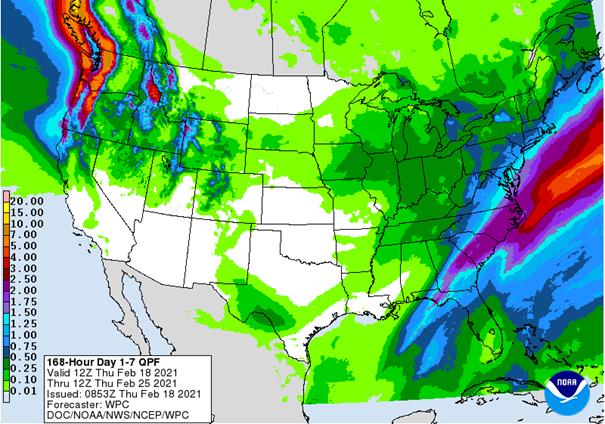
U.S.
Weather in the next week -
A
serious ice storm will impact Virginia, North Carolina, Maryland and neighboring areas today -
Snow
will pile up today from the Appalachian Mountains and parts of central and western North Carolina into New York and New England -
Snowfall
will vary from 3 to 10 inches and local amounts over 12 inches with the mountains of Pennsylvania, West Virginia and Virginia being most impacted -
One
more shot of cold air will push through the eastern U.S. following this week’s storm system -
Weather
systems this weekend and next week will move in quick succession across parts of the Plains and into the Midwest maintaining moisture abundance -
Melting
snow is also expected in the Plains late this week into next week -
No
more threatening cold is expected after Thursday morning -
Another
relatively large storm may impact the lower Midwest and middle Atlantic Coast states late next week -
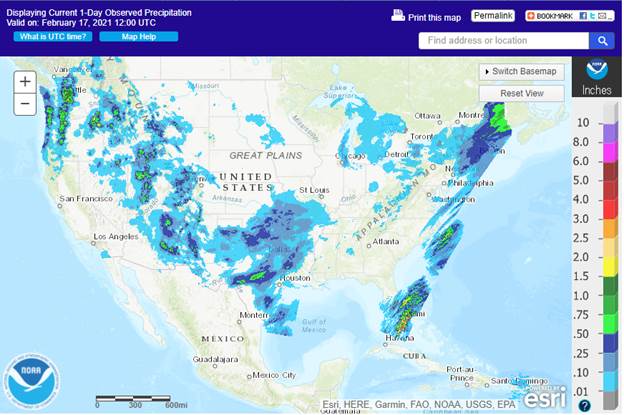
Snow
fell significantly from the Delta into the Tennessee River Basin, southwestern Pennsylvania and a part of the lower Midwest Wednesday -
Accumulations
of 2 to 6 inches were common with a few totals of 7 inches or more -
Temperatures
were still bitterly cold across the Plains and parts of the Midwest Wednesday, but readings will slowly moderate over the next few days -
Southern
Ghana and Ivory Coast received additional Wednesday -
Some
flowering might have occurred since some of this region reported rain Tuesday as well -
Greater
and more uniform rain is needed to induce a more generalized bout of flowering in coffee and cocoa areas, but the showers occurring now are not unusual for February and should increase next month -
Other
areas in west-central Africa will see most of this week’s rain occurring near the coast -
Southeast
Asia weather is not likely to change much in the coming week, although some additional heavy rain will overtake much of the Philippines this weekend into early next week causing some local flooding -
A
tropical cyclone is possible this weekend in southern and central Philippines -
East-central
Africa precipitation over the next ten days will be most significant in Tanzania and lightest in Ethiopia -
All
of the rain will be welcome and beneficial -
Southern
Oscillation Index weakened during the weekend and this trend will continue this week -
Today’s
SOI was +12.74 today and the index will move erratically over the next week -
Mexico
precipitation in the coming week will be mostly confined to the east coast. although a few showers may occur briefly in the far north too -
Central
America precipitation will continue greatest along the Caribbean Coast and in Guatemala while the Pacific Coast is relatively dry -
Canada
Prairies will experience warmer temperatures over the next several days week with readings becoming much closer to normal -
Precipitation
will continue limited -
Southeast
Canada will experience near normal amounts of precipitation in the coming week while temperatures are seasonable.
Source:
World Weather Inc. and FI
Thursday,
Feb 18:
- EIA
weekly U.S. ethanol inventories, production - USDA
Net Export Sales, 8:30am - USDA
Corn, Cotton, Soybean, Wheat Acreage Outlook, 8:30am - Sime
Darby Plantation earnings - Port
of Rouen data on French grain exports
Friday,
Feb 19:
- ICE
Futures Europe weekly commitments of traders report, 1:30pm (6:30pm London) - CFTC
commitments of traders weekly report on positions for various U.S. futures and options, 3:30pm - FranceAgiMer
crop conditions report - USDA
Corn, Cotton Soybean, Wheat End Stock Outlook, 7am - U.S.
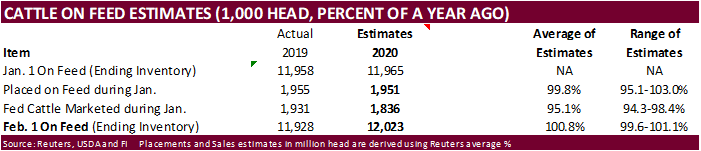
Cattle on Feed, 3pm
Monday,
Feb 22:
- USDA
Export Inspections – corn, soybeans, wheat, 11am - EU
weekly grain, oilseed import and export data - MARS
crop bulletin - Ivory
Coast cocoa arrivals - EARNINGS:
Wilmar - HOLIDAY:
Russia
Tuesday,
Feb 23:
- USDA
Milk production, 3pm - U.S.
pork, beef, poultry cold storage data, 3pm - U.K.
National Farmers Union virtual annual conference to discuss the future of agriculture, horticulture - EARNINGS:
IOI Corp. - HOLIDAYS:
Japan, Russia
Wednesday,
Feb 24:
- EIA
weekly U.S. ethanol inventories, production - Amsterdam
sustainable cocoa conference (Feb 24-26) - U.S.
poultry slaughter, 3pm - MPOB
palm oil prices seminar
Thursday,
Feb 25:
- USDA
weekly crop net-export sales for corn, soybeans, wheat, cotton, pork, beef, 8:30am - Port
of Rouen data on French grain exports - International
Grains Council monthly report - Malaysia’s
Feb. 1-25 palm oil export data - USDA
red meat production, 3pm - EARNINGS:
Minerva, BRF, FGV (tentative), Golden Agri
Friday,
Feb 26:
- ICE
Futures Europe weekly commitments of traders report, 1:30pm (6:30pm London) - CFTC
commitments of traders weekly report on positions for various U.S. futures and options, 3:30pm - U.S.
agricultural prices paid, received, 3pm - Earnings:
Olam - HOLIDAY:
Thailand
RINS
The
following is a table of the credit generation for the month of January by credit type.
RINs Volume (Gal.)
D3
4,442,298 4,442,298
D4
300,219,091 190,219,039
D5
19,415,774 12,580,794
D6
1,077,475,275 1,075,130,541
Source
Reuters and FI
US
Initial Jobless Claims Feb 13 861K (est 765K; prevR 848K; prev 793K)
–
US Continuing Claims Feb 6 4.494 Mln (est 4.413 Mln; prevR 4.558 Mln; prev 4.545 Mln)
US
Housing Starts Jan 1.580 Mln (est 1.658 Mln; prevR 1.680 Mln; prev 1.669 Mln)
–
US Building Permits Jan 1.881 Mln (est 1.678 Mln; prevR 1.704 Mln; prev 1.709 Mln)
US
Import Price Index (M/M) Jan 1.4% (est 1.0%; prev 0.9%)
–
US Import Price Index Ex. Petroleum (M/M) Jan 0.9% (est 0.4%; prev 0.4%)
–
US Import Price Index (Y/Y) Jan 0.9% (est 0.4%; prev -0.3%)
–
US Export Price Index (M/M) Jan 2.5% (est 0.8%; prev 1.1%)
–
US Export Price Index (Y/Y) Jan 2.3% ( prev 0.2%)
Canada
ADP Employment Change Jan -231.2K (prevR 338.0K; prev -28.8K)
US
DoE Crude Oil Inventories (W/W) 12-Feb: -7257K (est -2150K; prev -6645K)
–
Distillate Inventories: -3422K (est -1549K; prev -1732K)
–
Cushing OK Crude Inventories: -3028K (prev -658K)
–
Gasoline Inventories: 372K (est 1477K; prev 4259K)
–
Refinery Utilization: 0.1% (est -0.3%; prev 0.7%)
Corn.
-
Corn
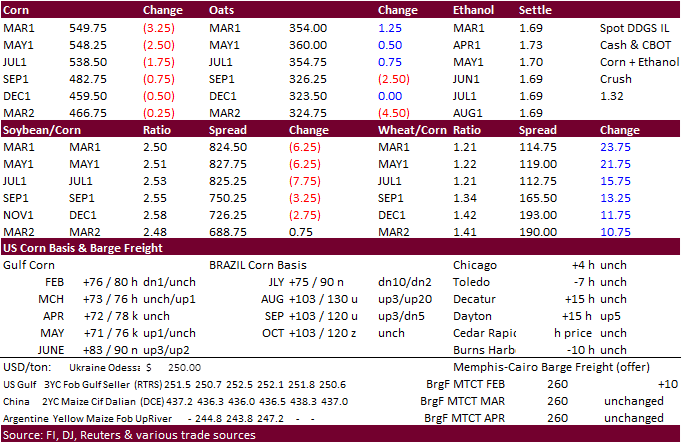
futures ended mostly lower in part to bear spreading in soybeans. Less than expected 92 million area US corn planting outlook for 2021 (92.9 Reuters guess) did little to stop overall selling but in the end may have influenced late bear spreading. News was
light. Some traders were waiting out to see what the extent of the damage had from the recent US cold temperatures and heavy snow prompting reports of forces majeures for exports. We are hearing US logistic problems started easing yesterday. USDA export
inspections on Monday will be the first indication if the cold weather had a significant impact on exports. Texas ranchers, home to about 13 million cattle, are still working around the clock to save animals from the cold weather and lack of fresh water.
-
March
support over the short term is seen at $5.47. -
Euronext
suspended trading in its corn futures and options contracts for January 2023 pending a review of technical specifications. -
The
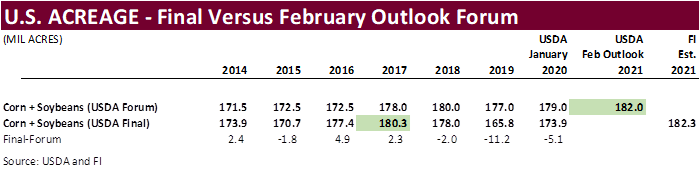
92 million acres USDA projected for the US corn crop was the only figure that initially stood out this morning in USDA’s “2021 Agricultural Economic & Foreign Trade Outlook” speech, as it came in below trade expectations. But combining soybeans (90.0), the
182.0 million acre outlook would be a record for any year if realized. Historically the final planted area varies from USDA’s initial outlook.
Weekly
US ethanol production
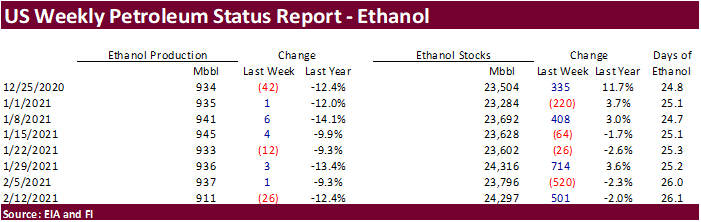
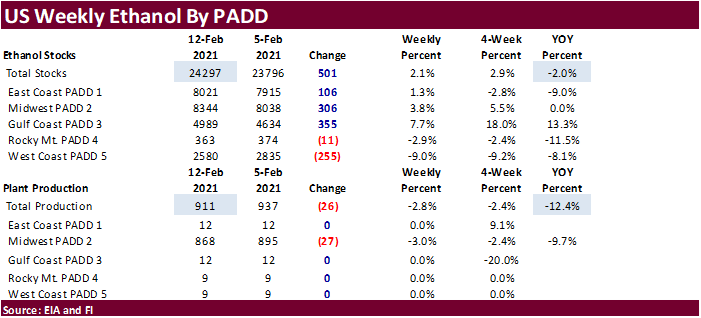
last week was off 26,000 barrels to 911,000 barrels (trade was looking down 17,000) and stocks were up 501,000 barrels to 24. (trade 48,000 increase) from the previous week. Ethanol production was lowest since September 25. Stocks are at a three-week high.
Early September to date ethanol production is running 8.5 percent below the same period a year ago. Based on weekly ethanol production, implied corn use using September to date average weekly ethanol production suggests 5.162 billion bushels, but if ethanol
production from now until the end of the year remained unchanged, implied use would stand at 5.067 billion bushels. However, several ethanol plants went offline earlier this week, or slowed, and we it is nearly impossible to predict when US ethanol production
will return to a pre-pandemic level, so those figures can’t be taken seriously. USDA is using 4.950 billion. US gasoline stocks increased 672,000 barrels to 257.1 million. US gasoline demand was up from the previous week but overall running 5.7 percent
below a year ago. US crude oil stocks fell to lowest since March.
Corn
Export Developments
·
None reported
Updated
2/10/21
March
corn is seen trading in a $5.20 and $6.00 range
May
corn is seen in a $5.15 and $6.00 range.
July
is seen in a $5.00 and $6.00 range.
December
corn is seen in a $3.75-$5.50 range.