
PDF Attached
Lower
trade in the US agriculture markets as investors book profits and some fund managers liquidate longs to cover other investment spaces.

- Argentina
crop weather remains favorably rated especially for a La Nina year - Crop
production potentials have improved in recent weeks because of routinely occurring rainfall and improved soil moisture - A
complete reversal of production losses is not possible because of early season corn and sunseed production losses - Argentina’s
most critical time for determining yields will be over the next few weeks - Timely
rain must continue along with seasonable temperatures - Argentina’s
soil moisture is favorably rated today and will carry crops through the coming week of more limited rainfall - Wednesday
of this week through February 10 will be mostly dry - Showers
that occur Feb. 10-15 may not be well distributed and the situation will need to be closely monitored - Temperatures
will turn warmer than usual late this week through most of next week, although not excessively hot - Subsoil
moisture will be sufficient to carry on normal crop development through the next ten days with or without rainfall, but moisture will be needed thereafter - Brazil’s
driest region remains in the northeast where parts of Piaui, Bahia, eastern Tocantins and Minas Gerais have all experienced moisture stress recently - Relief
is coming with periodic rainfall expected over the next ten days improving topsoil moisture, reducing crop stress and supporting better plant development - Most
of Brazil outside of the northeast has had well distributed rainfall and seasonable temperatures in recent weeks supporting a big improvement in crop and field conditions - The
improvements have bolstered soybean production since much of the increased rainfall has occurred while pod setting and filling occurred - Some
production cut is still expected relative to what might have been if rainfall occurred more normally this year, but the nation will still produce a large crop - Brazil
needs infrequent rain in soybean harvest areas to support quick maturation and good harvest progress and to support a good start to Safrinha corn and cotton planting - Rain
is expected often enough in the coming week to prevent the most aggressive fieldwork from occurring, but progress will be made around the precipitation
- Sufficient
rainfall will occur in Brazil’s main grain and oilseed production areas during the next two weeks to maintain a good outlook for full season crops and for both late maturing soybeans and early developing Safrinha crops - China
winter crops are still rated very good with little change likely - India’s
winter crops are in favorable condition, but there is need for rain to ensure the best winter crop yields; most winter crops are either approaching or entering reproduction making the next few weeks very important for rainfall and seasonable temperatures - India’s
weather over the second half of this week and into the weekend will include some showers in northern and eastern parts of its winter crop region - The
moisture will be welcome, but a little too light outside of the far north to seriously change production potential - More
rain would be welcome - Russia
and Ukraine weather will be warmer than usual over the coming week allowing for some additional snow melt to take place - Cooling
is expected a little later in the forecast period, but no bitter cold or threatening conditions will come to unprotected wheat or any other winter crop - Snow
will eventually return to some of the southern crop areas - Drought
still remains deep into the ground from Turkey into Ukraine, Russia’s Southern region and parts of Kazakhstan and these areas will be closely monitored during the spring and summer for signs of returning crop stress - Despite
the drought status many areas have seen and will continue to see periodic precipitation to improve topsoil moisture for at least a good start to the spring growing season - Western
Europe continues to experience frequent precipitation event that have the ground saturated and vulnerable to flooding - Some
flooding has already occurred this winter in random locations and more is expected until drier biased conditions evolve
- There
is not much threat of a widespread flood event or widespread crop damage, but if a large storm comes into the region producing heavy rainfall that could change - Northern
Africa will receive some welcome rain during the coming week to ten days - Southwestern
Morocco needs rain most with this being the third year of drought - Far
northeastern Morocco and northwestern Algeria is another area that will need timely rainfall this spring to induce the best production - Most
other areas in Northern Africa are in good shape and expected to perform well in the spring as long as timely precipitation evolves - South
Africa soil moisture and predicted rainfall will ensure good summer crop development over the next few weeks - The
nation is expecting high yields and production from nearly all crops - Eastern
Northern Cape will be the only drier biased area during the next two weeks, but irrigation is used to supplement rainfall in the region and that will maintain a good outlook for the majority of crops - Australia’s
eastern sorghum, cotton and other summer crop region has seen improved weather this summer, but conditions have not been ideal and Queensland still has a big need for generalized rainfall of significance - Dryland
production in Queensland would improve with greater rainfall frequency and intensity
- New
South Wales rainfall recently has been favorable distributed and sufficient to induce crop improvements in many areas - Little
change in Australia’s weather is expected for a while scattered showers and thunderstorms will impact summer crop areas, but some of the resulting rain may continue a little lighter and less frequent than desired especially in Queensland - Temperatures
have been and will continue to be seasonable - North
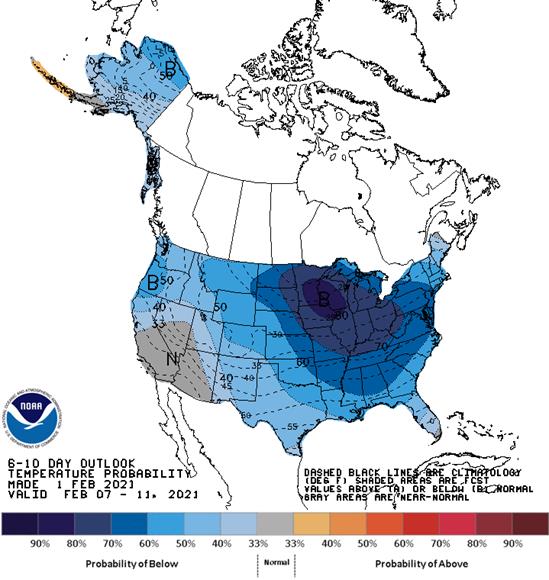
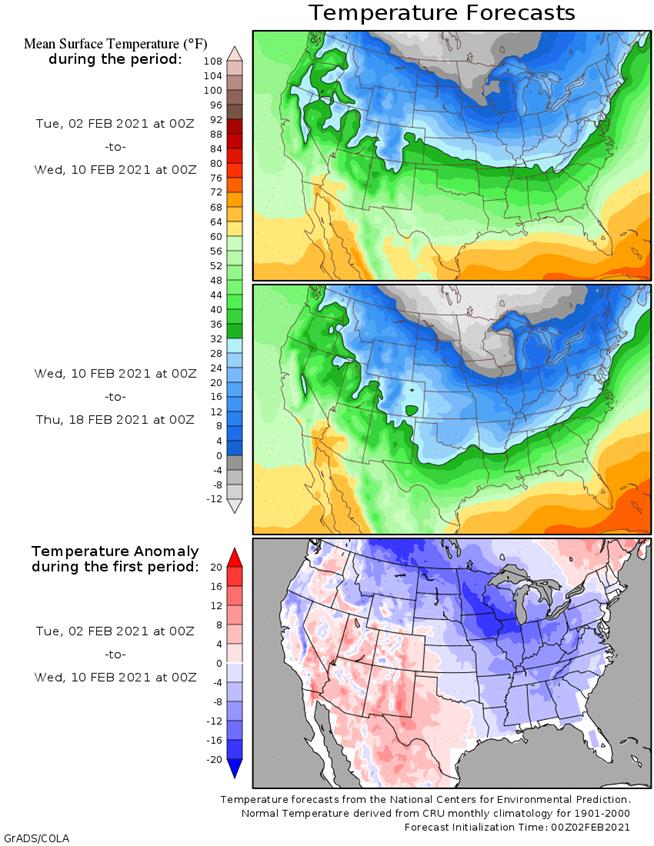
America is bracing for an arctic surge that will pass through Canada’s Prairies late this week and into the central United States during the weekend and early part of next week - Temperatures
will fall in the -40s and -30s Fahrenheit in Canada’s Prairies this weekend, the -20s and negative teens in the northern Plains with a couple of extremes near -30 near the Canada border and below zero Fahrenheit as far south as eastern Colorado, northern Kansas,
northern Missouri and northwestern Indiana - Warming
is expected briefly next week, but another wave of cold is expected later in the week and toward mid-month - U.S.
winter storm is expected in the heart of the Midwest Thursday and Friday with snow and rain expected - Snow
accumulations will range from 3 to 9 inches and locally more from Iowa to Michigan and a dusting to 2 inches elsewhere - Moisture
totals will vary from 0.15 to 0.60 inch with local totals to 1.25 inches - A
couple of weak weather systems will move across the Midwest this weekend and next week producing light snow
- Another
major winter storm is possible late next week and into the following weekend in the southeastern U.S. Plains, Delta, lower and eastern Midwest and then up the Atlantic coast - Confidence
in this event is low due to its huge size and changes are very likely in future model runs - The
storm’s timing may also change - U.S.
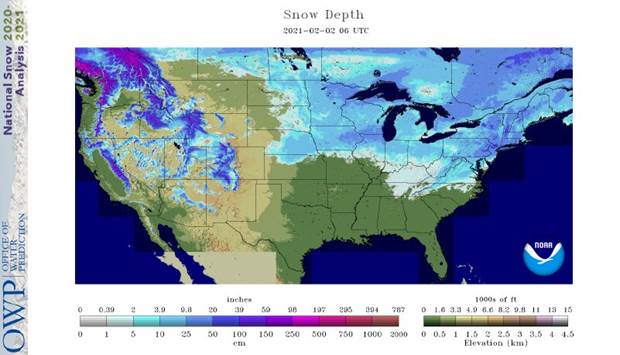
hard red winter wheat areas will get cold enough this weekend to raise concern over wheat conditions, but snow cover is expected to be present as protection against winterkill - The
situation needs to be closely monitored because of the potential for only light snowfall in some areas and the potential for wind-blown snow to leave some crop areas snow free during the coldest mornings - Sunday
will be coldest - Snow
cover in Montana and the western Dakotas as well as areas north through Alberta and Saskatchewan is warranted because of the extreme cold that is expected late this week and into the weekend - Unprotected
wheat may be damaged without snow - Snow
is expected in many areas, but wheat may not be covered sufficiently in some areas to adequately protect crops and a close watch on the situation is warranted.
- California’s
stormy weather of late has greatly improved mountain snowpack and soil moisture; however, snow water equivalents are still only 58-73% of normal for this time of year and only 34-46% of the April 1 normal - More
precipitation is needed, but a drier biased pattern is expected to evolve again after Wednesday - U.S.
Pacific Northwest precipitation events will become more limited over the next two weeks, but snowpack in the Cascade Mountains is very good - Other
areas in the region would benefit from additional precipitation - Drought
remains a concern across much of the interior western United States, Mexico and eastern Canada’s Prairies - The
status of drought is unlikely to change much for the next few weeks - Southern
Oscillation Index weakened during the weekend and this trend will continue this week - Today’s
SOI was +14.93 today and the index will continue slowly declining this week - Southeast
Asia weather is not likely to change much over the coming week - Mainland
areas have been and will continue to be mostly dry - Philippines
rainfall will be erratic and mostly light, but it may increase somewhat during the next ten days - Indonesia
and Malaysia rainfall has been erratic, but sufficient in maintaining a very good crop development environment - No
excessive rain occurred recently and little is anticipated for a while - Some
heavy rain fell in the Lesser Sunda Islands in southern Indonesia during the weekend - Southeastern
Mexico will get most of the rain periodically during the next ten days - The
precipitation will be erratic and mostly light, but still welcome wherever it occurs - Many
areas in Mexico are still dealing with long term drought - Central
America precipitation will continue greatest along the Caribbean Coast while the Pacific Coast is relatively dry - Canada
Prairies will be colder than usual during the next two weeks and periodic precipitation is expected - The
greatest cool off is expected in the second half of this week through early next week when bitter cold conditions are expected
- Most
of the precipitation will be light - Southeast
Canada will experience near average temperatures this week with some brief periods of precipitation expected
Source:
World Weather Inc. and FI
Tuesday,
Feb 2:
- U.S.
Purdue Agriculture Sentiment - New
Zealand global dairy trade auction - U.S.
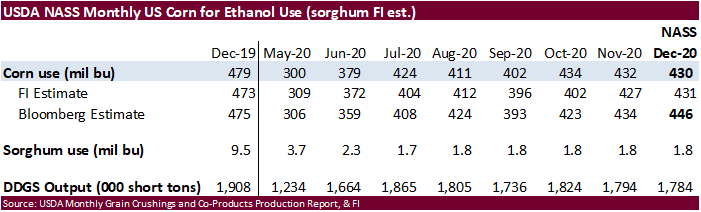
corn for ethanol, 3pm
Wednesday,
Feb 3:
- EIA
weekly U.S. ethanol inventories, production, 10:30am - New
Zealand Commodity Price
Thursday,
Feb 4:
- FAO
World Food Price Index; cereals supply/demand brief - USDA
weekly crop net-export sales for corn, soybeans, wheat, cotton, pork, beef, 8:30am - Port
of Rouen data on French grain exports
Friday,
Feb 5:
- US
Trade Balance - Statcan
reports on wheat, soy, durum, canola and barley stockpiles in Canada - ICE
Futures Europe weekly commitments of traders report, 1:30pm (6:30pm London) - CFTC
commitments of traders weekly report on positions for various U.S. futures and options, 3:30pm - China’s
CNGOIC to publish soybean and corn reports
WTI
Reaches $55/bbl For First Time In A Year
Corn.
-
Corn
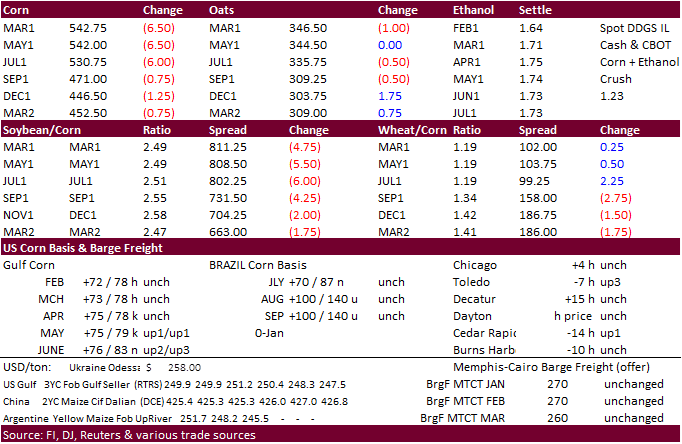
futures ended 5.50-6.25 cents lower in the nearby front three positions on fund liquidation and higher USD despite higher energy markets. September finished unchanged. Over the past couple of trading sessions USDA announced 24-hour sales, but they did not
include China, and this left some wondering if China is done buying corn for a while after picking up roughly 5.8 million tons last week.
South
Korea’s KOCOPIA bought about 60,000 tons of corn. -
Argentine
had some disruptions to grain exports after protestors set up roadblocks at some Buenos Aires terminals, according to CIARA chamber of export companies. We heard there are some disruptions in the south, an area were vessels top off commodities before they
set sail. A source mentioned wheat and barley was at least affected. Some think the strike will expand.
-
China
will sell 30,000 tons of frozen pork from state reserves on February 4, and another 30,000 tons on Feb. 9. -
A
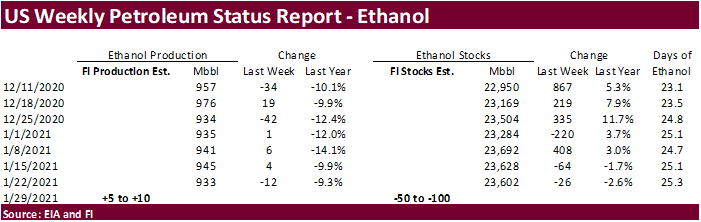
Bloomberg poll looks for weekly US ethanol production to be down 1,000 at 932,000 barrels (918-941 range) from the previous week and stocks up to 83,000 barrels to 23.685 million.
Corn
Export Developments
·
Under the 24-hour announcement system private exporters sold 115,000 tons of corn to Mexico for 2020-21 delivery.
·
South Korea’s KOCOPIA bought about 60,000 tons of corn at an estimated $300.84 a ton c&f for arrival in South Korea around April 25.
Updated
1/29/21
March
corn is seen trading in a $5.15 and $6.00 range.
May
corn is seen in a $5.00 and $6.00 range.
July
is seen in a $4.90 and $5.75 range.
December
is seen in a $3.75-$5.50 range.
-
The
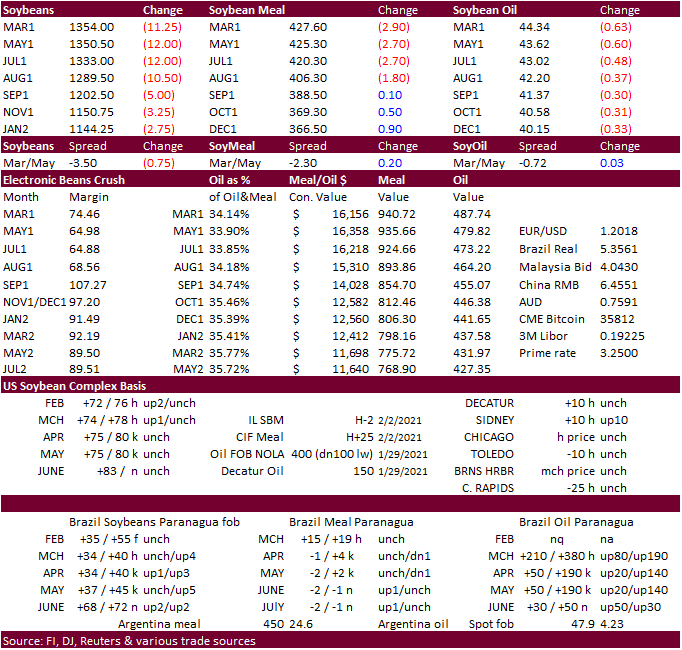
soybean complex ended mostly lower led by the front months on slowing US export developments, technical selling and a higher USD. March soybeans finished dwell off their session low at $13.5475, down 10.50 cents. Note $12.98 was the absolute low on Jan 25.
A setback to that level may indicate a technical head and shoulders pattern, a bearish signal. The USD is hovering around a 6-week high. Some of the outside ag markets were suggesting a lower trade in the CBOT products today.
-
Favorable
weather is seen for Argentina and most of Brazil. Some parts of Brazil will remain too wet for harvest this week.
-
Malaysian
palm oil futures fell 99 MYR and cash dropped 2.2% after coming back from a one day holiday. China soybean futures fell 1.4%, meal off 0.8% and SBO was down 1.3%. Offshore product values are indicating a lower trade for meal and oil.
-
Note
the Brazilian trucker strike started yesterday. This and a small Argentina strike should be monitored this week.
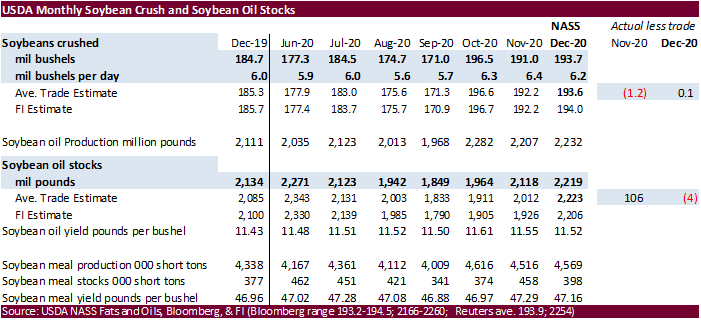
Oilseeds
Export Developments
·
Results awaited: Egypt’s GASC seeks at least 30k soybean oil and 10k sunflower oil on Feb 2 for March 10-30 arrival.
·
Egypt’s GASC seeks at least 3,000 tons of soyoil and 2,000 tons of sunflower oil on Wednesday.
Updated
1/26/21
March
soybeans are seen in a $13.25 and $14.75 range
March
soymeal is seen in a $410 and $480 range
March
soybean oil is seen in a 42.50 and 45.00 cent range
- US
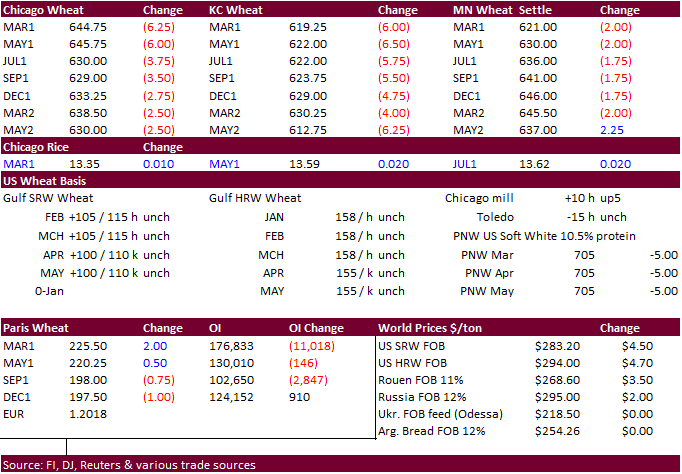
wheat fell today on follow through selling, a higher USD (hit a 2-month high), and slowing US export developments. Losses were limited after Egypt bought 480,000 tons of wheat from multiple destinations, but the US was not one of them. EU wheat was higher
as Egypt picked up four cargoes from France. EU
March milling wheat settled up 2.50 euros, or 1.1%, at 226.00 euros ($271.52) a ton.
MN
March ended 2.0 cents lower, KC 6.25 cents lower and March Chicago 6.25 lower.
- The
US central areas and northern Great Plains will see two cold shots this week, raising the risk of some winterkill for uncovered snow areas.
- Egypt
bought 480,000 tons of wheat for March 15-30 shipment. Traders gave the following breakdown of the purchase in dollars per ton: -
60,000
tons of Russian wheat at $295.80 and $15.40 freight = $311.20 -
60,000
tons of Russian wheat at $295.80 and $15.40 freight = $311.20 -
60,000
tons of Ukrainian wheat at $294.85 and $16.35 freight = $311.20 -
60,000
tons of Romanian wheat at $296.60 and $14.63 freight = $311.23 -
60,000
tons of French wheat at $291.70 and $20.25 freight = $311.95 -
60,000
tons of French wheat at $291.70 and $20.25 freight = $311.95 -
60,000
tons of French wheat at $291.70 and $20.25 freight = $311.95 -
60,000
tons of French wheat at $291.70 and $20.25 freight = $311.95 -
Japan
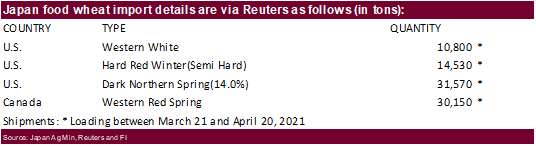
seeks 87,050 tons of food wheat this week.
- 7
offers: Jordan is in for another 120k wheat on Feb 3 and 120k barley on Feb 2.
·
CME Raises COMEX Silver Futures Margins By 18%
·
Iraq seeks 30,000 tons of rice on Feb 3, valid until Feb 10, optional origin.
·
Syria is in for 25,000 tons of rice on February 9.
Updated
2/2/21
March
Chicago wheat is seen in a $6.35‐$7.15 range
March
KC wheat is seen in a $6.00‐$6.70 range (lowered 25 low end)
March
MN wheat is seen in a $6.00‐$6.55 range
Terry Reilly
Senior Commodity Analyst – Grain and Oilseeds
Futures International
One Lincoln Center
18 W 140 Butterfield Rd.
Oakbrook Terrace, Il. 60181
W: 312.604.1366
ICE IM:
treilly1
Skype: fi.treilly

Trading of futures, options, swaps and other derivatives is risky and is not suitable for all persons. All of these investment products are leveraged, and you can lose more than your initial deposit. Each investment product is offered
only to and from jurisdictions where solicitation and sale are lawful, and in accordance with applicable laws and regulations in such jurisdiction. The information provided here should not be relied upon as a substitute for independent research before making
your investment decisions. Futures International, LLC is merely providing this information for your general information and the information does not take into account any particular individual’s investment objectives, financial situation, or needs. All investors
should obtain advice based on their unique situation before making any investment decision. The contents of this communication and any attachments are for informational purposes only and under no circumstances should they be construed as an offer to buy or
sell, or a solicitation to buy or sell any future, option, swap or other derivative. The sources for the information and any opinions in this communication are believed to be reliable, but Futures International, LLC does not warrant or guarantee the accuracy
of such information or opinions. Futures International, LLC and its principals and employees may take positions different from any positions described in this communication. Past results are not necessarily indicative of future results.
 Evecom-FI020221.pdf